


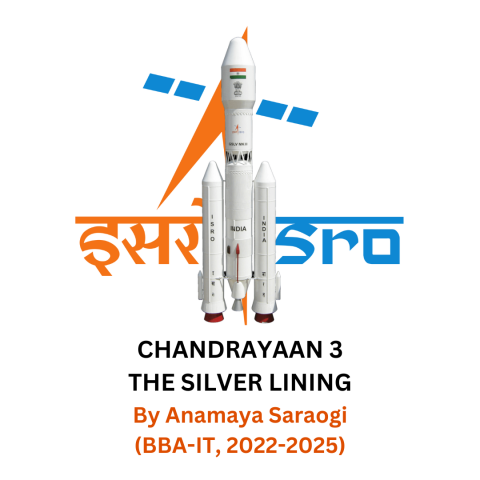
India is celebrating the successful completion of phase 1 of mission Chandrayaan 3. This article will delve into the significance that the accomplishment of this mission holds for India. Before we discuss Chandrayaan 3, it is important we know about the previous lunar expeditions India has undertaken.
The Indian Lunar Odyssey began in 2008 with the launch of Chandrayaan1 which played a crucial role in confirming the presence of water on the moon. It proved to be a fillip to scientific advancements and lunar advancements across the globe. The moon, which was deemed dry and inhabitable, was confirmed to have water on its surface.
India’s second lunar probe, Chandrayaan2 was set in motion with the objective of further investigating the extent of water distribution on the moon’s surface and exploring its south pole which lies in the shadows. It was believed that the craters in this region were home to fossil remains of the early solar system which held answers to questions regarding the origin and evolution of this celestial body. Among these its aim was to demonstrate the soft landing of a lander and rover on the moon. To much of India’s dismay, the lander (Vikram) crashed on the moon, proving to be a great setback for the nation and cause of criticism for the ISRO. However, the mission was not a complete failure. It was revealed by the space agency that the orbiter had produced significant data regarding the surface, subsurface and the exosphere of the moon.
India is back with its second attempt at safe landing on the moon. Chandrayaan 3 took off successfully from the Satish Dhawan Space Center in Andhra Pradesh on 14th July with the intent of achieving what its predecessor failed to. It is expected to land after 42 days around 23rd August. The success of this mission is India’s ticket into the band of nations, currently consisting of the US, Russia and China, that have accomplished lunar landings.
Taking a lesson from the last time, the Chandrayaan 3 has been built keeping in mind all the elements that led to the failure of the previous mission. This 600 crore project is fitted with not one, but two “lander hazard detection and avoidance cameras”. The Vikram lander is now modified to have stronger legs and an increased landing velocity which enables it to manage complex landing situations. It is also fitted with solar panels to ensure endless supply of power.
Chandrayaan 3 is a major stimulus to India’s first human spaceflight programme, Gaganyaan. The project aims to test human spaceflight abilities by launching a crew of 3 members to an orbit of 400 km for 3 days and bringing them abc safely by landing in Indian sea waters.The same rocket which launched Chandrayaan 3 will be used for this ambitious project. As per information by ISRO chairman S. Somnath, the first abort mission for Gaganyaan will be held towards the end of August.
Chandrayaan 3 is a message of hope from ISRO to the world. Despite the heartbreaking failure of its last mission, the space agency has proved that ambition, hardwork and optimism can make one reach great heights…even the moon.
Bibliography
- https://solarsystem.nasa.gov/missions/chandrayaan1/indepth/
- https://www.isro.gov.in/Chandrayan_2.html
- https://indianexpress.com/article/explained/explainedscitech/chandrayaan...
- https://www.india.com/news/india/isroschandrayaan3allsettolaunchtodayhow...
- https://economictimes.indiatimes.com/news/science/isrosfirsthumanspacefl...
By Anamaya Saraogi, (2022-25)