


Background:
Research shows that at least 197.3 million Indians suffer from Mental
health issues such as Depressive Disorders (45.7M), Anxiety Disorders
(44.9M), Schizophrenia (7.7M-12.4M), Bipolar disorder (4.9M-9.6M) and
more such as Autism spectrum Disorder, Attention-Deficit Hyperactive
Disorder and Eating Disorders. In 2017 one in seven Indians were
affected by Mental Disorders in varying Severity but still Mental health
is a huge stigma in the Indian Society. In this article we are going to
take a look at What stigma the Patients actually face, the reasons for it
and actual ways to eliminate stigma.(Source)
What is Stigma, Mental Health Stigma:
Stigma is divided into two different types: societal stigma and self-
stigma. In simple terms societal stigma is disproval or discrimination
against a person for having mental health conditions and self-stigma
occurs when a person is living in a society filled with stigma and
accepts those norms for themselves as well. Some examples of mental
health stigma might be a lack of approval from society for example:
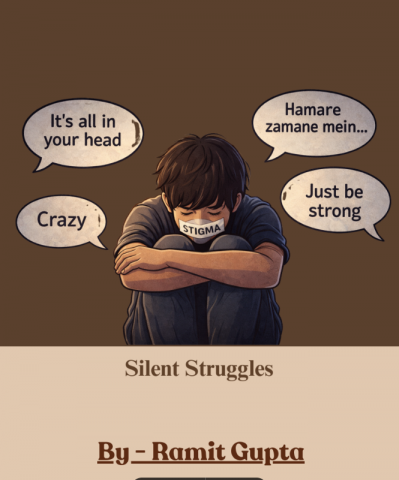
A student goes and tells their mother that they’re facing mental health
problems such as Depression and Anxiety. What would a normal
response from an Average Parent be? “There is no such thing as anxiety
or depression” or “Hamare zamane main toh ye sab nahi hota tha”.
Other examples of stigmatised people being dismissive of mental
issues are statements such as “The only cure to conditions like ADHD is
thinking you don’t have ADHD” or “You don’t actually suffer from ADHD
you guys just pick disorders that you like from reels.”
Social media also has a very big part in spreading misinformation and
stigma which we’ll talk about later.
Relation between stigma and Youth:
Studies conducted in India suggested that one third of the youth
displayed poor knowledge about mental health problems and negative
attitude towards those who suffer from mental health problems and
20% of the youth actually showed stigmatized behaviour.(Source)
Why does this stigma exist:
There are may causes for this Stigma including:
- Lack of Knowledge - Stigma is caused due to ignorance and a lack
of Information in society, thinking mental illness is a personal
failing, believing mental health problems aren’t “real illnesses”. - Cultural Beliefs and Traditional Experiences - Stigma is also
caused by incorrect vales passed down from generations. India as
a society is not individual oriented but rather group oriented
which was seen when researchers found differences in the
behaviours of people suffering from mental health issues in India,
while people in US were facing self-stigma while people in India
were more likely to see it as a collective problem which reflects
as a bad image for the family (Group). - Prejudice, Stereotypes, and Social Values - Fear of Social
judgement is very high in India as a result families tend to hide
mental Health issues instead of addressing them. Families tend to
fear social judgement and tend to think their reputation will suffer
due to a family member’s mental health issues, People are often
labelled unstable or mentally unfit.
Real world effects:
Due to all the things listed above people facing from mental health
issues suffer from problems like not being able to talk about their
feelings with anyone even their peers due to fear of rejection and
dismissal or the fear of being labelled in a certain way. Studies suggest
people facing mental health issues have trouble finding a partner for
marriage facing constant rejections since people facing mental health
problems are not considered suitable partners thus face significant
stress and discrimination. The following are some statements from
people suffering from mental health stigma in India:
‘They consider that as a shame. When we tell others about the illness,
they call it madness’ (Patient 49, Female, Hindu, Chottinikkara)
‘Brother called me as “mental girl” and it hurt me badly’ (Patient 61,
Female, Hindu, Edappally)
‘Families need to be sensitive to people with such illness, my brother-
in-law committed suicide because his family wasn’t supportive
enough’(Caregiver 28, Rural Malappuram)
These real-world effects can often have grave and drastic
consequences as seen in the third quote from the caregiver of a patient.
(Source)
Solutions:
Since stigma is a very complicated problems with many different
causes, the solutions to be implemented are also multiple:
- Educating People and Raising Awareness – Accurate knowledge
about mental health conditions is one of the most effective ways
to fight stigma. Education helps people understand that mental
health disorders are real, common, and treatable — not signs of
weakness or moral failings. SICSR also holds many awareness
programs for young students to get educated about Mental health
and be more inclusive - Open Conversations and Talk About It - Encouraging people to talk
openly — whether in schools, families, colleges, or social media —
helps normalize mental health. When mental health is brought
into everyday conversation, it becomes less frightening and less
taboo. This is why SIU holds regular workshops and Discussions
where Mental health ambassadors join discuss their experiences
facing stigma and real world issues. - Training and Workshops in Schools/Colleges - Evidence shows
that educational programs and stigma reduction workshops in
schools and universities can improve young people’s attitudes and
knowledge about mental health. Combining education with contact
(e.g., talks from people with lived experience) yields better effects.
This is also why SIU hosts many different online workshops
regarding mental health and Mental health awareness where
Mental health Ambassadors from all Institutes take part. - Supportive Policies and Public Initiatives - Policies that support
mental health access — like anti-discrimination guidelines,
counselling services, and national programs — help reduce
structural stigma (the systems that make people afraid to seek
help). Governments can launch awareness campaigns and expand
access to care (e.g., through helplines and tele-mental health
services).
Conclusion:
Mental health stigma in Indian society is serious issue rooted from
ignorance, fear, and deeply ingrained social norms. While younger
generations are more aware of mental health issues, stigma continues
to persist through misinformation, cultural beliefs, and fear of social
judgement. The real-world consequences of this silence are severe,
affecting relationships, self-worth, and even survival. Reducing stigma
requires a national level effort from the Government and the Public—
through education, open dialogue, institutional support, and
compassionate policies. Mental health must be treated with the same
seriousness as physical health. Only then can society move from
silence and shame toward understanding, acceptance, and healing.
By- Ramit Gupta
BCA 2024-28